
1. Einleitung
This manual provides instructions for the Viltrox PFU RBMH 20mm f/1.8 ASPH manual focus lens. This ultra-wide prime lens is designed for Nikon Z-mount mirrorless cameras, including models such as Z5, Z50, Z6, Z6 II, Z7, Z7 II, Z9, and Zfc. It offers a broad field of view and a bright f/1.8 maximum aperture, making it suitable for astrophotography, landscape, interior, and architectural photography.
The lens features an optical design with aspherical and low dispersion elements to reduce aberrations and an HD Nano multi-layer coating to minimize flare and ghosting. It is constructed from brass for durability and smooth operation.
Wichtige Sicherheitshinweise:
- Do not expose the lens to direct sunlight for extended periods, as this may damage the camera sensor or lens elements.
- Vermeiden Sie es, das Objektiv fallen zu lassen oder starken Stößen auszusetzen.
- Halten Sie die Linse von Wasser und Feuchtigkeit fern.
- Do not attempt to disassemble or repair the lens yourself. Contact authorized service personnel for assistance.
2. Einrichtung
2.1 Packungsinhalt
Überprüfen Sie, ob alle Artikel im Paket vorhanden sind:
- Viltrox PFU RBMH 20mm f/1.8 ASPH Lens
- Frontlinsenkappe
- Linsenkappe hinten
- Gegenlichtblende
- Objektivbeutel
- 82-mm-Filteradapterring
- Bedienungsanleitung (dieses Dokument)

Figure 2.1: Included accessories with the Viltrox 20mm f/1.8 lens.
2.2 Identifying Lens Parts
Familiarize yourself with the different parts of your Viltrox 20mm f/1.8 lens:
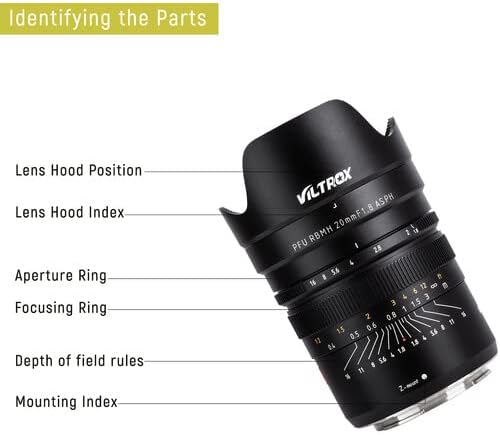
Figure 2.2: Key components of the Viltrox PFU RBMH 20mm f/1.8 ASPH lens.
- Lens Hood Position: Where the lens hood attaches.
- Lens Hood Index: Alignment mark for attaching the lens hood.
- Blendenring: Used to manually set the lens aperture (f-stop).
- Focusing Ring: Used to manually adjust the focus.
- Depth of Field Rules: Markings indicating the depth of field at various apertures and focus distances.
- Montageindex: Ausrichtungsmarkierung zur Befestigung des Objektivs am Kameragehäuse.
2.3 Anbringen des Objektivs an Ihrer Kamera
- Stellen Sie sicher, dass Ihre Kamera ausgeschaltet ist.
- Entfernen Sie den hinteren Objektivdeckel vom Objektiv und den Gehäusedeckel von Ihrer Kamera.
- Align the mounting index mark on the lens with the corresponding mark on your camera's lens mount.
- Setzen Sie das Objektiv vorsichtig in die Kamerafassung ein und drehen Sie es im Uhrzeigersinn, bis es einrastet. Wenden Sie dabei keine Gewalt an.
- To remove the lens, press the lens release button on your camera body and rotate the lens counter-clockwise until it detaches.

Figure 2.3: Viltrox 20mm f/1.8 lens properly mounted on a Nikon Z camera.
3. Bedienung
3.1 Manuelle Fokussierung
Dies ist ein Objektiv mit manuellem Fokus. Um eine scharfe Fokussierung zu erreichen:
- Set your camera to manual focus (MF) mode.
- Schauen Sie durch die viewfinder or use the camera's LCD screen.
- Rotate the focusing ring on the lens until your subject appears sharp. Utilize your camera's focus peaking or magnification assist features for precise focusing.
- The lens has a 148.5° focus throw, allowing for fine adjustments.
- The minimum focusing distance is 9.8 inches (0.25 meters).

Figure 3.1: The focusing ring and aperture ring on the Viltrox 20mm f/1.8 lens.
The engraved focus distance and depth of field scales on the lens barrel can assist with pre-focusing and hyperfocal distance techniques, especially useful for landscape and astrophotography.

Figure 3.2: The lens offers excellent close-up ability with a minimum shooting distance of 0.25m (9.84 inches).
3.2 Setting the Aperture
The lens features an aperture ring for manual control of the f-stop. Rotate the aperture ring to select your desired aperture value, ranging from f/1.8 to f/16. The bright f/1.8 maximum aperture is ideal for low-light conditions and creating shallow depth of field with pleasing bokeh, thanks to its 14-blade diaphragm.
3.3 Using the Lens Hood
The included lens hood helps to block stray light from entering the lens, reducing flare and ghosting, and provides some physical protection to the front element. To attach the lens hood, align its index mark with the lens hood index on the lens and rotate until it locks into place. To remove, reverse the process.

Figure 3.3: Lens with attached hood for flare reduction and protection.
3.4 Anbringen von Filtern
The lens has an 82mm filter thread. An 82mm filter adapter ring is included to facilitate the attachment of screw-in filters. Screw the filter adapter ring onto the front of the lens, then attach your 82mm filter to the adapter ring.
4. Wartung
4.1 Reinigung der Linse
- Linsenelemente: Use a soft lens brush or a blower to remove dust. For smudges or fingerprints, use a clean microfiber lens cloth with a small amount of lens cleaning solution. Wipe gently in a circular motion from the center outwards. The HD Nano coating is water-resistant, but avoid excessive moisture.
- Objektivgehäuse: Reinigen Sie das Objektivgehäuse mit einem weichen, trockenen Tuch. Verwenden Sie keine organischen Lösungsmittel wie Verdünner oder Benzol.
- Always keep the front and rear lens caps on when the lens is not in use to protect the elements from dust and scratches.
4.2 Speicherung
- Bewahren Sie das Objektiv an einem kühlen, trockenen und gut belüfteten Ort auf, fern von direkter Sonneneinstrahlung und hoher Luftfeuchtigkeit.
- If storing for an extended period, place it in a sealed container with desiccant packets to prevent mold and mildew growth.
- Avoid storing the lens with mothballs or chemicals that may emit volatile gases.
5. Fehlerbehebung
| Problem | Mögliche Ursache | Lösung |
|---|---|---|
| Cannot attach lens to camera. | Falsche Ausrichtung oder Blockierung. | Ensure the mounting index marks are aligned. Check for any debris on the lens mount or camera body. Do not force the lens. |
| Images are blurry/out of focus. | Falsche manuelle Fokussierung. | Ensure camera is in MF mode. Carefully adjust the focusing ring. Use camera's focus peaking or magnification assist. |
| Excessive flare or ghosting in images. | Strong light source hitting the front element. | Attach the lens hood. Reposition to avoid direct light sources. |
| Dust or smudges on lens elements. | Exposure to environment, improper handling. | Clean lens elements as described in Section 4.1. |
6. Spezifikationen
| Besonderheit | Beschreibung |
|---|---|
| Marke | VILTROX |
| Modellname | PFU RBMH 20mm f/1.8 ASPH |
| Brennweite | 20mm (30mm equivalent on DX-format cameras) |
| Maximale Blendenöffnung | f/1.8 |
| Minimale Blende | f/16 |
| Objektivanschluss | Nikon Z |
| Fokustyp | Manueller Fokus |
| Minimale Fokusentfernung | 0.25 m (9.8 Zoll) |
| Optisches Design | 12 elements in 9 groups (including 4 ED elements, 1 double-sided aspherical element, and 1 highly transparent element) |
| Blendenlamellen | 14 (gerundet) |
| Filtergröße | 82 mm |
| Beschichtung | HD Nano multi-layer coating (water-resistant) |
| Winkel von View | 94 Grad |
| Baumaterial | Brass lens barrel |
7. Garantie und Support
For detailed warranty information and customer support, please refer to the official VILTROX website or contact your local VILTROX distributor. Keep your purchase receipt as proof of purchase for warranty claims.
Official VILTROX Store: VILTROX Official Store on Amazon