Einführung
This instruction manual provides detailed guidance for the Science Can Circuit Super Kit, an educational electronic circuit board kit designed for children aged 8 to 12 years. This kit offers 80 exciting experiments to introduce fundamental principles of electricity and circuit design in an engaging and interactive way. Please read this manual thoroughly before beginning any experiments to ensure safe and correct usage.
Lieferumfang
The Science Can Circuit Super Kit includes a comprehensive set of components necessary for conducting various experiments. Please verify that all items listed below are present in your kit:
- Power Supply (requires 3 AAA batteries, not included)
- Piano module
- Bulb module
- RGB-Lamp Modul
- Speaker module
- Lüftermodul
- Buntes Lamp Modul
- Motormodul
- Flying Saucer module
- Schaltmodul
- Push Switch module
- Potentiometer module
- Vibrating module
- Resistor modules (10-Ohm and 100-Ohm)
- Transparent Base Plate
- 6 Drähte
- 2 T-shaped Wires
- Instruction Manual (74 pages)

Image: All components of the Circuit Super Kit, including the transparent base plate, various modules (light show, fan, RGB lamp, speaker, bulb, microphone, photoresistors, switches, potentiometer, vibrating, resistors, colorful lamp, flying saucer, power supply, hand crank generator, piano, FM radio), and connecting wires.

Image: An illustrative diagram labeling the key components of the circuit kit, demonstrating how they connect to form simple circuits.
Aufstellen
Follow these steps to set up your Science Can Circuit Super Kit:
- Komponenten auspacken: Entnehmen Sie vorsichtig alle Komponenten aus der Verpackung.
- Batterien einlegen: Locate the Power Supply module. Open the battery compartment and insert 3 AAA batteries, ensuring correct polarity. Close the compartment securely.
- Prepare Base Plate: Place the transparent base plate on a flat, stable surface. This plate serves as the foundation for your circuits.
- Platzierung der Komponenten: The modules are designed to snap onto the base plate. Refer to the instruction manual for specific placement guides for each experiment.
- Kabel anschließen: Use the provided wires to connect the modules as indicated in the experiment diagrams. The wires feature USB-C type connectors for easy and secure attachment.
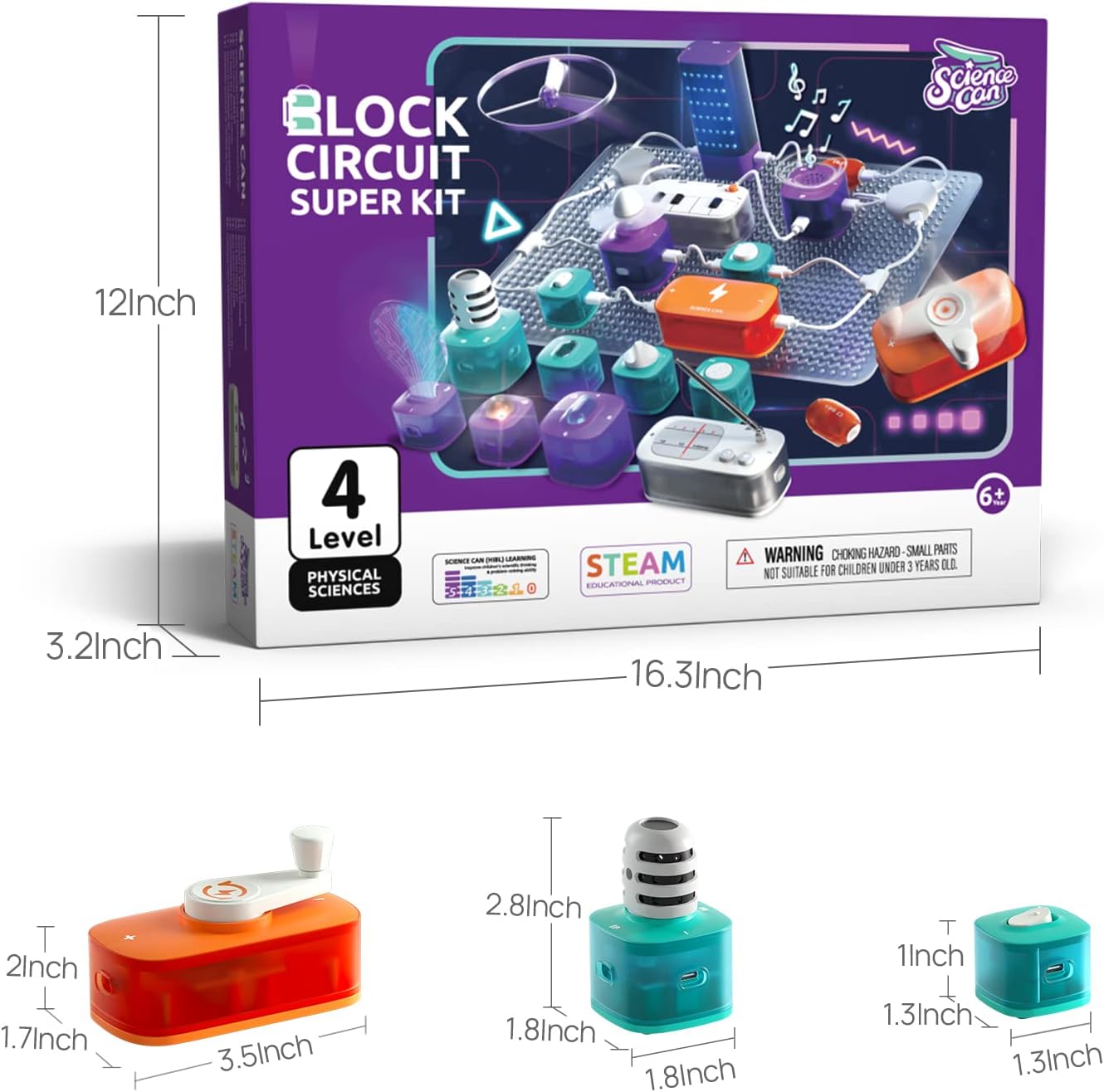
Image: A transparent base plate with various circuit components connected, illustrating the modular design and ease of assembly.
Operating Instructions: Experiments
The kit includes a 74-page instruction manual with 80 experiments, ranging from basic circuits to more complex projects. Each experiment is designed to be completed step-by-step, teaching the underlying scientific principles.
- Select an Experiment: Choose an experiment from the instruction manual. The first 13 experiments focus on basic circuitry.
- Folgen Sie den Diagrammen: Carefully follow the illustrated diagrams and instructions provided for each experiment.
- Bauen Sie die Schaltung zusammen: Connect the specified modules using the wires on the transparent base plate according to the diagram.
- Testen Sie den Schaltkreis: Once assembled, activate the circuit (e.g., by pressing a switch or turning on the power supply) to observe the results.
- Understand the Principles: The manual explains the scientific concepts behind each experiment, encouraging learning and exploration.

Image: A child following clear, illustrated instructions to assemble a circuit, highlighting the user-friendly design of the manual and components.

Image: A visual representation of 80 exciting experiments, showcasing various circuit designs and their potential outcomes.
Wartung
Proper care and maintenance will extend the life of your Science Can Circuit Super Kit:
- Lagerung: Store all components in their original packaging or a designated container in a dry, cool place away from direct sunlight.
- Reinigung: Wipe components gently with a dry, soft cloth. Do not use water or cleaning solutions, as this can damage electronic parts.
- Batteriepflege: Remove batteries from the Power Supply module if the kit will not be used for an extended period to prevent leakage.
- Vorsichtig handhaben: Avoid dropping or applying excessive force to the modules and wires.
Fehlerbehebung
If you encounter issues while using your kit, refer to the following common problems and solutions:
- Schaltung funktioniert nicht:
- Ensure batteries are correctly inserted into the Power Supply module with the correct polarity.
- Prüfen Sie, ob die Batterien neu sind und ausreichend geladen sind.
- Verify all wire connections are secure and match the experiment diagram.
- Ensure all modules are properly snapped onto the base plate.
- Confirm that switches are in the 'ON' position where applicable.
- Intermittierende Funktionalität:
- This may indicate loose connections. Re-seat all wires and modules.
- Check battery contact within the power supply; sometimes batteries can shift.
- Komponentenfehlfunktion:
- If a specific module consistently fails across different circuits, it may be faulty. Contact customer support for assistance.
Technische Daten
| Technische Daten | 16.3 x 3.2 x 12 Zoll |
| Artikelgewicht | 2.88 Pfund |
| Modellnummer (ASIN) | B09NKPFXLW |
| Empfohlenes Alter | 8 - 12 Jahre |
| Batterien erforderlich | 3 AAA-Batterien (nicht im Lieferumfang enthalten) |
| Hersteller | Die Wissenschaft kann |
Garantie und Support
For warranty information, product support, or to purchase replacement parts, please refer to the official Science Can website or contact their customer service directly. Contact details can typically be found on the product packaging or the manufacturer's official online presence.


