1. Einleitung
The Raspberry Pi 4 Model B is a powerful, credit-card sized computer designed for a wide range of applications, from desktop computing to embedded projects. This 8GB RAM version offers enhanced performance for demanding tasks. It features a quad-core Cortex-A72 (ARM v8) 64-bit SoC, dual display support up to 4K@60Hz, true Gigabit Ethernet, 2.4 GHz and 5.0 GHz wireless LAN, Bluetooth 5.0, and upgraded USB 3.0 ports.
This manual provides essential information for setting up, operating, maintaining, and troubleshooting your Raspberry Pi 4 Model B.

Bild 1: Draufsicht view of the Raspberry Pi 4 Model B (8GB) board, showing the main components and ports.
2. Einrichtung
2.1 Erforderliche Komponenten
- Raspberry Pi 4 Model B (8GB) board
- Official Raspberry Pi USB-C Power Supply (5.1V, 3A) or equivalent
- MicroSD card (minimum 8GB, Class 10 recommended) with Raspberry Pi OS installed
- Micro HDMI to HDMI cable (x2 for dual display)
- USB-Tastatur und -Maus
- Monitor oder Fernseher mit HDMI-Eingang
- (Optional) Ethernet cable for wired network connection
2.2 Vorbereiten der microSD-Karte
- Download the Raspberry Pi Imager software from the official Raspberry Pi webWebsite.
- Insert your MicroSD card into a card reader connected to your computer.
- Open Raspberry Pi Imager, select your desired operating system (e.g., Raspberry Pi OS Full), and choose your MicroSD card.
- Click "Write" to install the operating system onto the MicroSD card. This process will erase all existing data on the card.
- Once the writing process is complete, safely eject the MicroSD card from your computer.
2.3 Anschließen von Peripheriegeräten
Before applying power, connect all necessary peripherals:
- MicroSD-Karte: Insert the prepared MicroSD card into the card slot on the underside of the Raspberry Pi.
- Anzeige: Connect one or two Micro HDMI to HDMI cables from the Raspberry Pi's Micro HDMI ports to your monitor(s).
- Tastatur und Maus: Schließen Sie Ihre USB-Tastatur und -Maus an die USB 2.0- oder USB 3.0-Anschlüsse an.
- Netzwerk (optional): For a wired connection, plug an Ethernet cable into the Ethernet port.
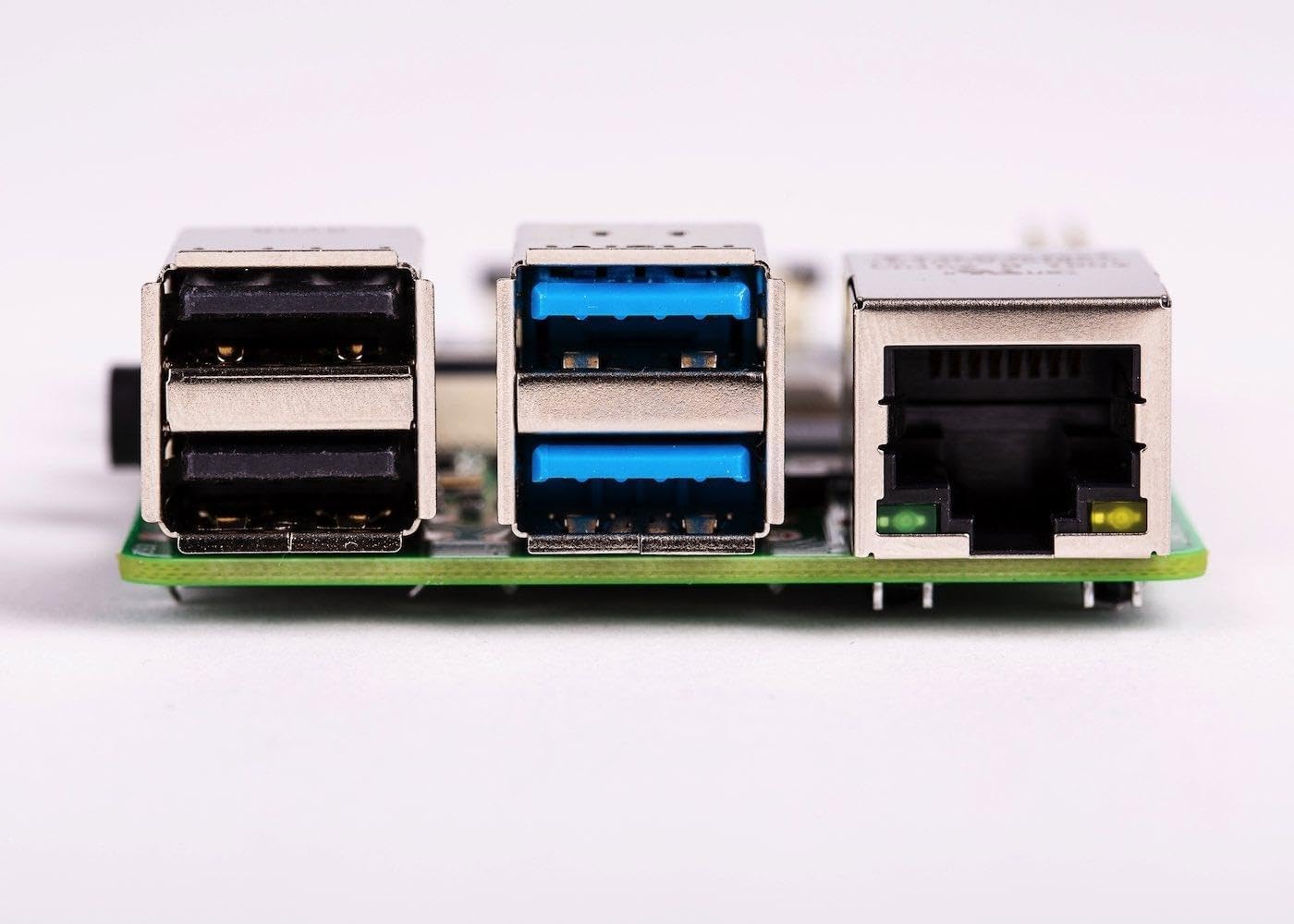
Abbildung 2: Seite view of the Raspberry Pi 4 Model B, highlighting the USB 2.0, USB 3.0, and Ethernet ports.
2.4 Einschalten
Once all peripherals are connected, plug the USB-C power supply into the Raspberry Pi's USB-C power port. The Raspberry Pi will automatically power on and begin the boot process. The red power LED will illuminate, and the green activity LED will flash during boot.
3. Bedienungsanleitung
3.1 Erster Start und Erstkonfiguration
On the first boot, Raspberry Pi OS will guide you through an initial setup wizard. This includes setting your country, language, timezone, creating a new password, connecting to Wi-Fi, and updating software. Follow the on-screen prompts to complete the setup.
3.2 Desktop Environment
After initial setup, you will be presented with the Raspberry Pi OS desktop environment. This functions similarly to other desktop operating systems, allowing you to browse the web, edit documents, program, and more.
3.3 Konnektivität
- W-lan: Connect to a wireless network using the network icon in the top-right corner of the desktop.
- Bluetooth: Pair Bluetooth devices via the Bluetooth icon in the top-right corner.
- Ethernet: If an Ethernet cable is connected, the Raspberry Pi will automatically establish a wired network connection.
3.4 GPIO-Header
The 40-pin GPIO (General Purpose Input/Output) header allows you to connect and control various electronic components and sensors. Refer to the official Raspberry Pi documentation for detailed information on GPIO programming and usage.

Abbildung 3: Oben view of the Raspberry Pi 4 Model B, showing the 40-pin GPIO header on the left side.
4. Wartung
4.1 Softwareaktualisierungen
Regularly update your Raspberry Pi OS to ensure optimal performance, security, and access to the latest features. Open a terminal and run the following commands:
sudo apt update
sudo apt full-upgrade -y
sudo reboot
4.2 Kühlung
The Raspberry Pi 4 can generate significant heat under heavy load. For sustained performance, especially in enclosed spaces or demanding applications, consider using a heatsink or an active cooling solution (e.g., a fan) to prevent thermal throttling.

Bild 4: Nahaufnahme view of the main processor chip on the Raspberry Pi 4 Model B, which can benefit from cooling solutions.
4.3 Sicheres Herunterfahren
Always shut down your Raspberry Pi properly to prevent data corruption on the MicroSD card. You can do this via the desktop menu (Menu > Shutdown > Shutdown) or by opening a terminal and typing:
sudo shutdown -h nowWait for the green activity LED to stop flashing before disconnecting power.
5. Fehlerbehebung
- Keine Anzeigeausgabe:
- Ensure Micro HDMI cables are securely connected to both the Raspberry Pi and the monitor.
- Überprüfen Sie, ob der Monitor auf die richtige Eingangsquelle eingestellt ist.
- Try a different Micro HDMI cable or monitor.
- Ensure the MicroSD card has a valid operating system installed.
- Power Issues (No LEDs, No Boot):
- Confirm you are using a compatible 5.1V 3A USB-C power supply.
- Check the power cable and connection.
- Versuchen Sie, falls vorhanden, ein anderes Netzteil.
- WLAN-/Bluetooth-Verbindungsprobleme:
- Ensure the Wi-Fi/Bluetooth module is enabled in the Raspberry Pi OS settings.
- Check for correct network credentials.
- Bringen Sie den Raspberry Pi näher an den drahtlosen Zugangspunkt heran.
- Stellen Sie sicher, dass keine physischen Hindernisse das Signal blockieren.
- Langsame Leistung:
- Check for excessive heat and consider adding a cooling solution.
- Ensure your MicroSD card is a high-speed (Class 10 or higher) card.
- Schließen Sie nicht benötigte Anwendungen.
- Führen Sie ein Softwareupdate durch.
For more detailed troubleshooting, visit the official Raspberry Pi documentation and community forums.
6. Spezifikationen
| Besonderheit | Detail |
|---|---|
| Prozessor | Broadcom BCM2711, Quad-Core Cortex-A72 (ARM v8) 64-Bit-SoC bei 1.5 GHz |
| RAM | 8 GB LPDDR4-2400 SDRAM |
| Konnektivität | 2.4 GHz and 5.0 GHz IEEE 802.11b/g/n/ac wireless LAN, Bluetooth 5.0, BLE, Gigabit Ethernet |
| USB-Anschlüsse | 2 × USB 3.0-Anschlüsse, 2 × USB 2.0-Anschlüsse |
| Video & Ton | 2 × Micro-HDMI-Anschlüsse (bis zu 4Kp60 unterstützt), 2-Lane MIPI DSI-Display-Anschluss, 2-Lane MIPI CSI-Kameraanschluss, 4-poliger Stereo-Audio- und Composite-Videoanschluss |
| GPIO | Standard 40-poliger GPIO-Header (vollständig abwärtskompatibel mit früheren Karten) |
| Leistung | 5V DC via USB-C connector (minimum 3A), 5V DC via GPIO header, Power over Ethernet (PoE) enabled (requires separate PoE HAT) |
| Maße | 2.76 x 1.97 x 0.39 Zoll (70 x 50 x 10 mm) |
| Betriebssystem | Raspberry Pi OS (formerly Raspbian) |

Bild 5: Nahaufnahme view of the dual Micro HDMI ports and the MIPI CSI camera port on the Raspberry Pi 4 Model B.
7. Garantie und Support
For warranty information and technical support, please refer to the official Raspberry Pi webBesuchen Sie die Website oder wenden Sie sich an Ihre Verkaufsstelle. Bewahren Sie Ihren Kaufbeleg für Garantieansprüche auf.
Offizieller Raspberry Pi WebWebsite: www.raspberrypi.org


