1. Einleitung
This manual provides essential instructions for the safe assembly, operation, and maintenance of your BILT HARD 40-Ton Gas Powered Log Splitter. Please read this manual thoroughly before using the equipment to ensure proper function and to prevent injury or damage. Keep this manual for future reference.
2. Sicherheitshinweise
Operating a log splitter requires strict adherence to safety protocols. Failure to follow these guidelines can result in serious injury or death.
Allgemeine Sicherheitsvorkehrungen:
- Tragen Sie stets geeignete persönliche Schutzausrüstung (PSA), einschließlich Schutzbrille, Gehörschutz, Arbeitshandschuhe und Sicherheitsschuhe mit Stahlkappen.
- Stellen Sie sicher, dass sich keine Umstehenden, Kinder oder Haustiere im Arbeitsbereich aufhalten.
- Bedienen Sie den Holzspalter auf einer festen, ebenen Fläche.
- Die Maschine darf niemals unter Alkohol- oder Drogeneinfluss bedient werden.
- Keep hands and feet away from moving parts, especially the splitting wedge and ram.
- Do not attempt to split logs larger than the recommended capacity (up to 24 inches in length).
- Always shut off the engine and allow it to cool before performing any maintenance or adjustments.
WARNING: Pinch Point Hazard
Keep hands clear of the splitting wedge and log catcher during operation. Serious injury can occur.
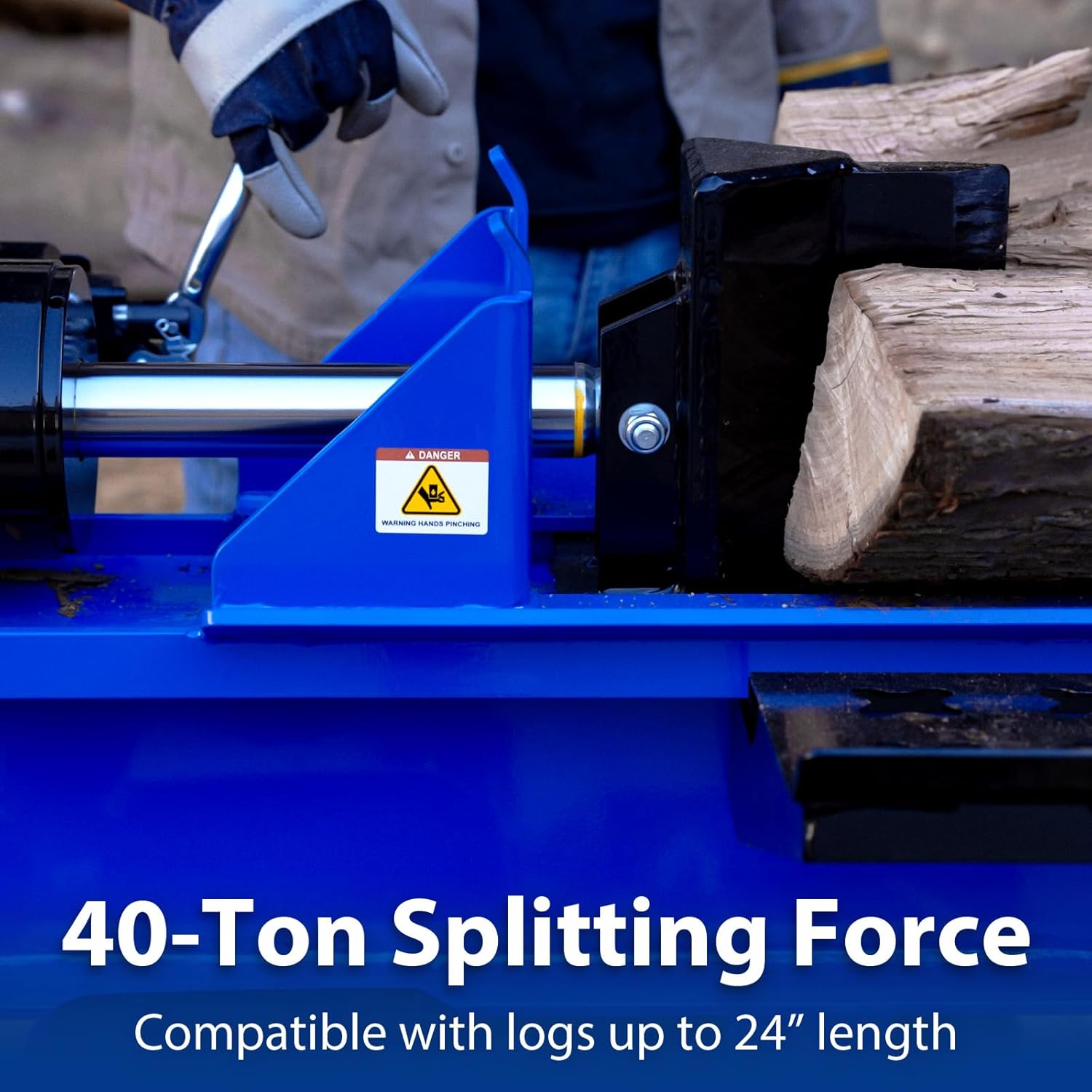
Image: Close-up of the log splitter's splitting wedge with a warning label indicating a pinch point hazard. A gloved hand is shown operating the control lever, with a log positioned for splitting.
3. Aufbau und Montage
The BILT HARD 40-Ton Log Splitter requires assembly. It is recommended that at least two people perform the assembly process. Refer to the assembly video for detailed visual guidance.
Erforderliche Werkzeuge:
- Gummi- oder Holzhammer
- 13 mm, 14 mm, 16 mm, 17 mm, 18 mm, 19 mm, 27 mm Schraubenschlüssel
- Großer verstellbarer Schraubenschlüssel
- Kreuzschlitz- oder Standard-Schraubendreher
- Zange
- 6-mm-Inbusschlüssel
Montageschritte:
- Auspacken: Place the shipping crate on a solid, flat surface. Carefully cut the shipping bands and disassemble the crate to access the components.
- Ölfilter einbauen: Using a 27mm wrench, install the oil filter into the corresponding port of the hydraulic tank. Tighten to a torque exceeding 60 N·m (a tolerance of ± 5° is allowed).
- Anhängerkupplung montieren: Remove the pre-installed bolts, washers, and lock nuts from the hydraulic oil tank. Rotate the support leg to a vertical position and lock it in place using the lock pin, ensuring the tow bar is approximately level with the ground. Attach the tow bar to the bracket on top of the hydraulic tank using the appropriate bolts, nuts, and washers. An 18mm or 19mm wrench will be needed.
- Montieren Sie die Räder: Remove the cotter pin and castle nut from the axle of the hydraulic oil tank. Remove plastic shipping caps, ensuring the tire valve stem faces outward. Slide the wheel onto the axle. If the wheel bearing is accidentally dislodged, reinstall it. Thread the castle nut onto the axle and tighten by hand. Adjust the castle nut to align the holes, making sure not to overtighten. Insert the cotter pin and bend with pliers. Install the axle cap using a soft mallet. Repeat for the other wheel.
- Den Balken einbauen: Stand the beam vertically on the foot plate. Remove the hitch pin and R-pin. Roll the hydraulic tank into position so the pivot holes on the tank and beam are aligned. Secure the beam with the hitch pin and R-pin. Block the wheels to prevent rolling and pivot the beam into the horizontal position. Check that the lock pin aligns and inserts smoothly into the corresponding hole on the tow bar.
- Motor einbauen: Place the engine and gear pump assembly onto the engine mounting plate of the hydraulic oil tank. Secure it with the appropriate hardware as specified in your operator's manual. A 13mm or 14mm wrench will be needed.
- Schläuche montieren: Remove the red shipping plug from the gear pump. Using the provided hose clamps, connect one end of the clear oil hose to the pump inlet and the other end to the hydraulic tank. Remove the white shipping plug from the gear pump, install the O-ring into the outlet fitting, then attach the hydraulic hose assembly's A-end to the pump outlet connector. Tighten with a torque of 50-60 N·m using a 27mm or adjustable wrench. Screw the B-end nut of the return hydraulic hose into the oil filter inlet connector and tighten with a torque of 70-80 N·m using a 27mm or adjustable wrench. Ensure both high-pressure hoses are connected to the correct positions.
- Installieren Sie die Holzfänger: Attach the large log catcher to the engine side of the beam using a 16mm wrench and appropriate bolts, nuts, and washers. Attach the small log catcher on the opposite side with appropriate bolts, nuts, and washers. A 17mm wrench and 6mm Allen wrench will be needed.
- Vollständige Installation: Entfernen Sie die Stifte vom Steuerventilhebel und sichern Sie den Hebel, indem Sie die Stifte wieder einsetzen, sobald er in die richtige Position gebracht wurde.
Montagevideo:
Video: Detailed assembly instructions for the BILT HARD Full Beam Gas Log Splitter, covering all steps from uncrating to final setup.
4. Bedienung
Your BILT HARD 40-Ton Log Splitter is designed for efficient and powerful wood splitting. Follow these steps for safe and effective operation.
Starten des Motors:
- Ensure the engine has sufficient fuel and oil.
- Follow the engine manufacturer's instructions for starting.
- Allow the engine to warm up for a few minutes before beginning operation.
Splitting Logs:
- Place the log firmly on the splitting beam against the wedge.
- Engage the control lever to extend the ram and split the log. The splitter features a 16-second cycle time for rapid processing.
- The heavy-duty log catcher helps contain split wood.
- The splitter can handle logs up to 24 inches in length and 100 lbs in weight.
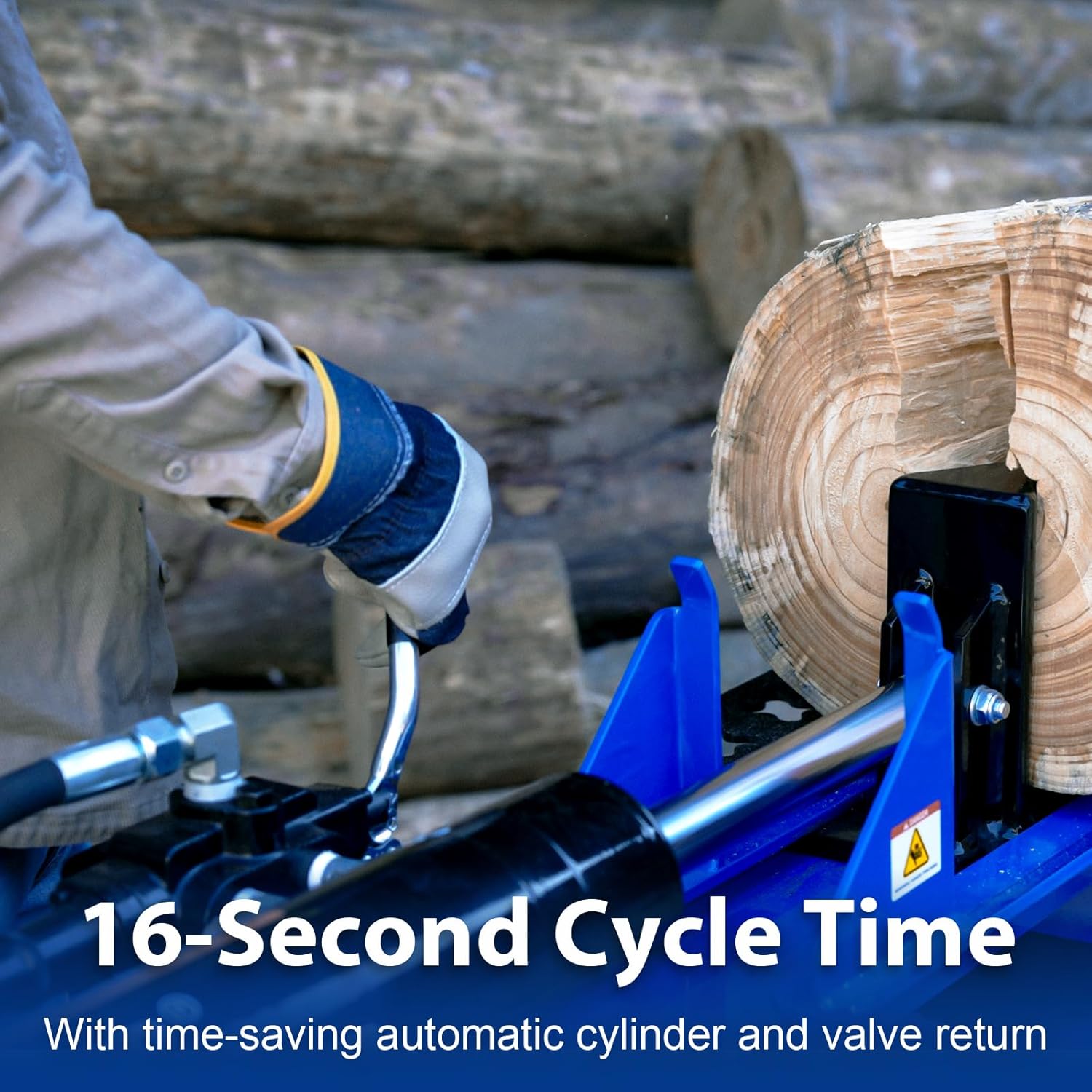
Image: A log splitter in operation, demonstrating the 16-second cycle time as a log is efficiently split by the hydraulic ram and steel wedge.
Horizontaler und vertikaler Betrieb:
This log splitter offers dual-position operation for versatility.
- Horizontaler Modus: Ideal for most logs, providing a stable splitting platform.
- Vertikaler Modus: For larger, heavier logs, reducing the need for heavy lifting. To switch, ensure the machine is off and secured, then pivot the beam to the vertical position and lock it in place.
Video: Overview of the BILT HARD 40-Ton Gas Powered Log Splitter, showcasing its splitting force, cycle time, engine, and dual horizontal/vertical operation.
5. Wartung
Regular maintenance is crucial for the longevity and safe operation of your log splitter.
Hydrauliksystem:
- The hydraulic oil system has a 7-gallon capacity and operates at 14 GPM.
- Regularly check the hydraulic fluid level and top up as needed with recommended hydraulic oil.
- Inspect hydraulic hoses for leaks, cracks, or damage. Replace any damaged hoses immediately.
- Ensure the oil filter is clean and replace it periodically to prevent contaminants from entering the system.
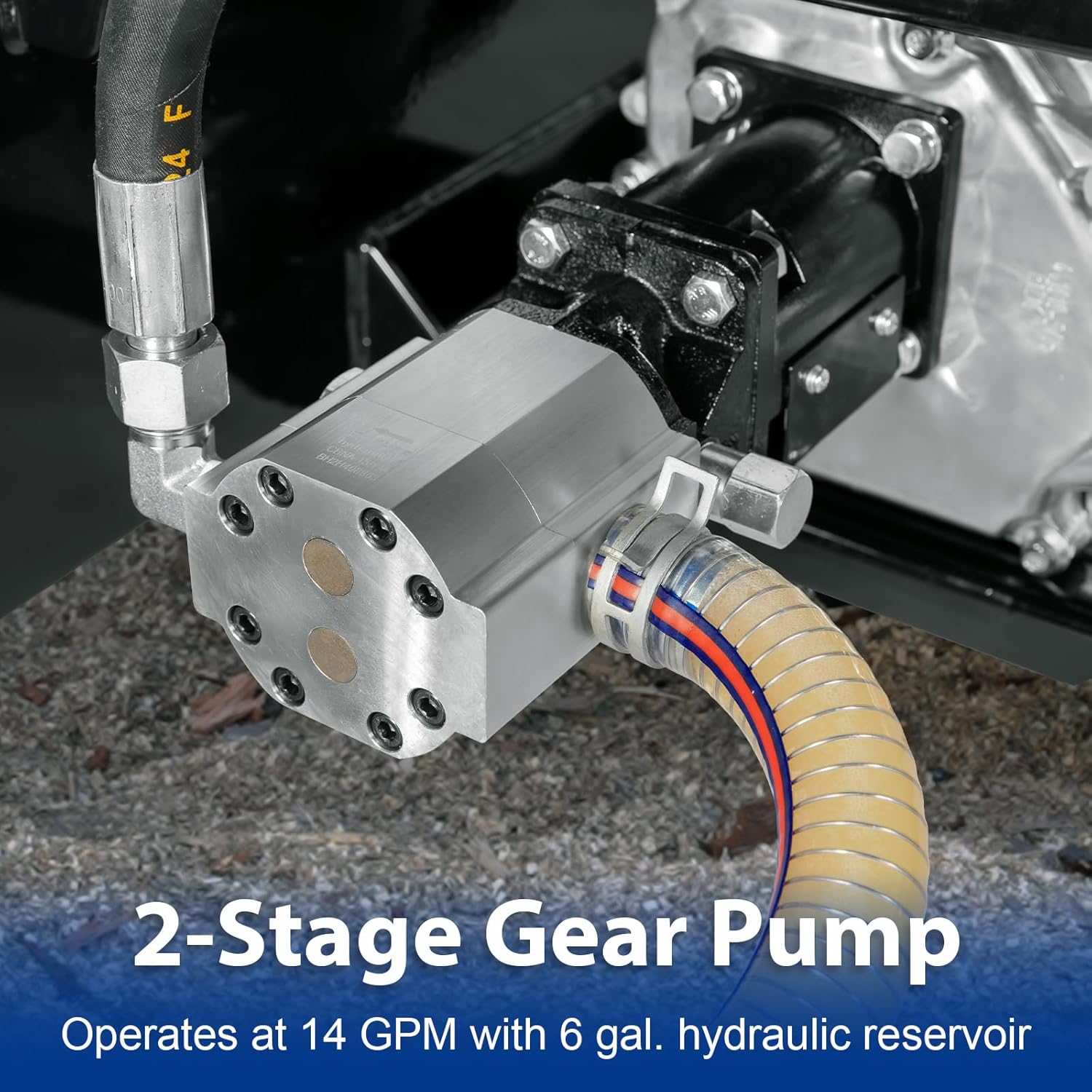
Bild: Eine detaillierte view der 2ertage gear pump, highlighting its connection to the hydraulic system. This component is vital for the splitter's performance.
Motorwartung:
- Check engine oil levels before each use and change according to the engine manufacturer's schedule.
- Reinigen oder ersetzen Sie den Luftfilter regelmäßig.
- Überprüfen Sie die Zündkerze und ersetzen Sie sie gegebenenfalls.
- Keep the engine free of debris to ensure proper cooling.

Image: A close-up of the robust 389cc OHV engine, the power source for the log splitter. The engine's air filter and fuel cap are visible, indicating points for routine maintenance.
Allgemeine Inspektion:
- Inspect all bolts, nuts, and fasteners for tightness.
- Check tires for proper inflation and wear.
- Lubricate all pivot points and moving parts as recommended.
6. Fehlerbehebung
This section provides general guidance for common issues. For detailed troubleshooting, refer to the comprehensive operator's manual or contact customer support.
Häufige Probleme:
- Motor startet nicht: Check fuel level, engine oil, spark plug, and air filter. Ensure the choke is set correctly.
- Loss of Splitting Force: Inspect hydraulic fluid level, check for hydraulic leaks, and ensure the control valve is functioning correctly.
- Slow Ram Movement: Verify hydraulic fluid level and condition. Check for obstructions in the hydraulic lines or issues with the pump.
- Ungewöhnliche Geräusche: Immediately shut down the machine and inspect for loose parts, damaged components, or low fluid levels.
7. Spezifikationen
| Besonderheit | Spezifikation |
|---|---|
| Spaltkraft | 40 Tonnen |
| Motortyp | 4-Cycle 389cc OHV Engine (13 HP, 16.96 ft.-lb. torque) |
| Maximale Protokolllänge | 24 Zoll |
| Zykluszeit | 16 seconds (with auto return) |
| Hydraulikölkapazität | 7 Gallonen |
| Hydraulic Pump Speed | 14 GPM (2-Stage Gear Pump) |
| Reifen | 16-inch DOT-certified pneumatic tires |
| Schleppgeschwindigkeit | Bis zu 45 km/h |
| Hitch-System | 2-inch ball coupler, 24-inch safety chains |
| Keil teilen | 8-inch hardened steel |
| Betriebsarten | Horizontal, Vertikal |
| Artikelgewicht | 76 Pfund |
| Verpackungsabmessungen | 73.65 x 28.07 x 24.62 Zoll |

Image: A diagram illustrating the key dimensions of the BILT HARD 40-Ton Log Splitter, including length, width, and height, along with its total weight of 530 lbs.
8. Garantie und Kundendienst
For any questions, problems, or assistance with your BILT HARD gas wood splitter, please contact our support team. Refer to the instruction manual and assembly video for proper setup and initial troubleshooting.
Kontaktinformationen:
- For customer service, please contact us via Amazon email.
- Assistance from our support team is readily available.
Specific warranty details may vary. Please refer to your purchase documentation or contact customer service for information regarding your product's warranty.


