1. Einleitung
The KGUSS TOPPING DX5II is a high-performance fully balanced DAC and headphone amplifier combo designed for superior audio reproduction. This manual provides essential information for setting up, operating, and maintaining your device.
Lieferumfang
- TOPPING DX5 II x 1
- Fernbedienung x 1
- USB-Kabel x 1
- AC-Kabel x 1
- 6.35 mm auf 3.5 mm Adapter x 1
- Bluetooth-Antenne x 1
- Produktinformationskarte x 1

2. Produktüberschreitungview und Hauptmerkmale
The DX5II is a new generation fully balanced DAC and headphone amplifier combo, offering significant upgrades and advanced functionalities for an enhanced audio experience.
Hauptmerkmale:
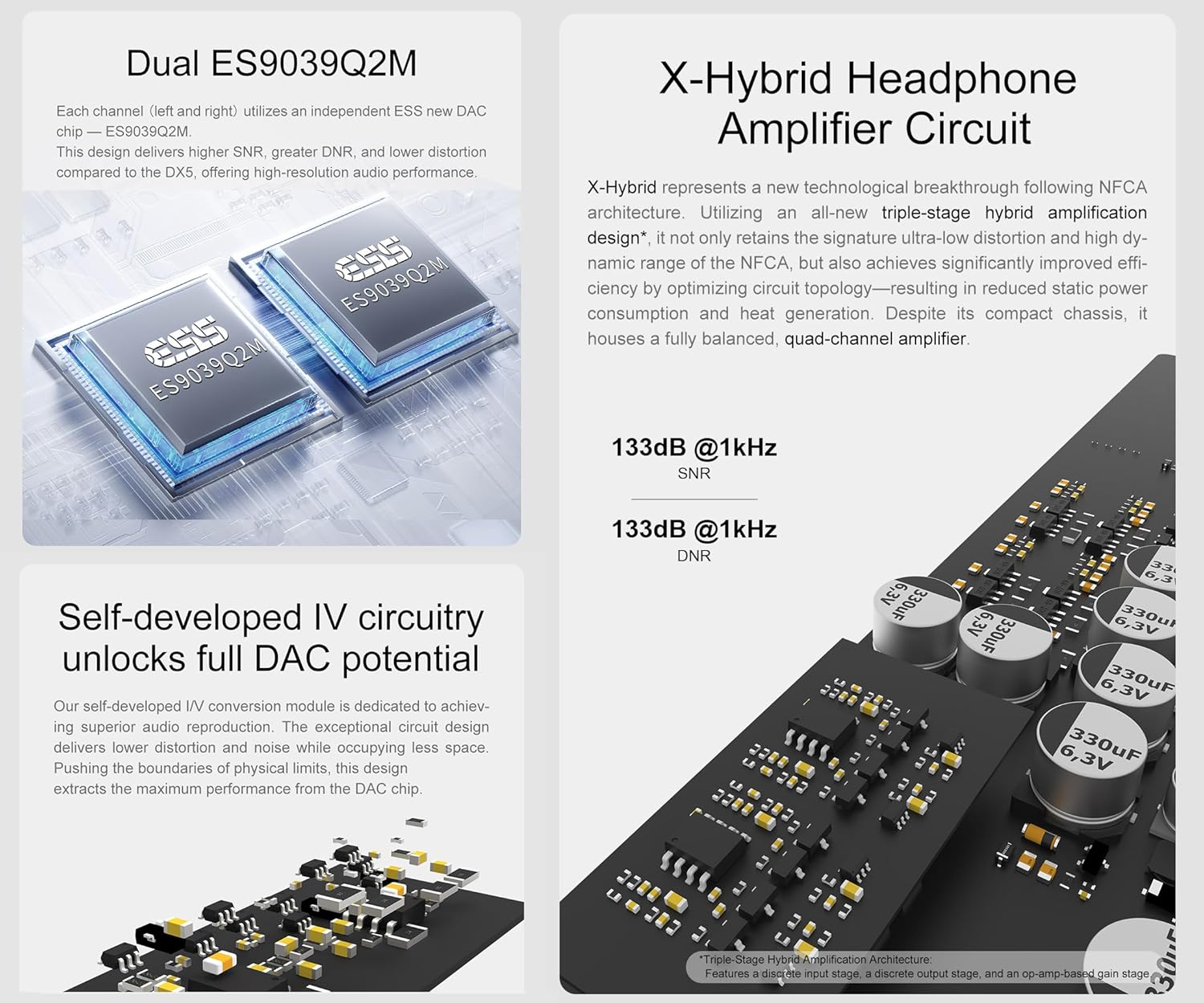
- Dual ES9039Q2M DAC Chips: Each channel utilizes an independent ESS ES9039Q2M DAC chip for lower crosstalk, improved imaging, 133dB SNR, 133dB dynamic range, and distortion as low as 0.00006%.
- X-Hybrid Headphone AmpSchaltkreis: Features an original triple-stagDer Hybrid amp circuit (discrete input, op-amp gain, discrete output) for high efficiency, improved thermals, and precise delivery. Power output peaks at 7600mW x2 into 16Ω.
- Wide Headphone Compatibility: Equipped with 6.35mm single-ended, 4.4mm balanced, and 4-pin XLR headphone jacks, suitable for low-sensitivity headphones to high-sensitive IEMs with a low noise floor of 1.8uVrms.
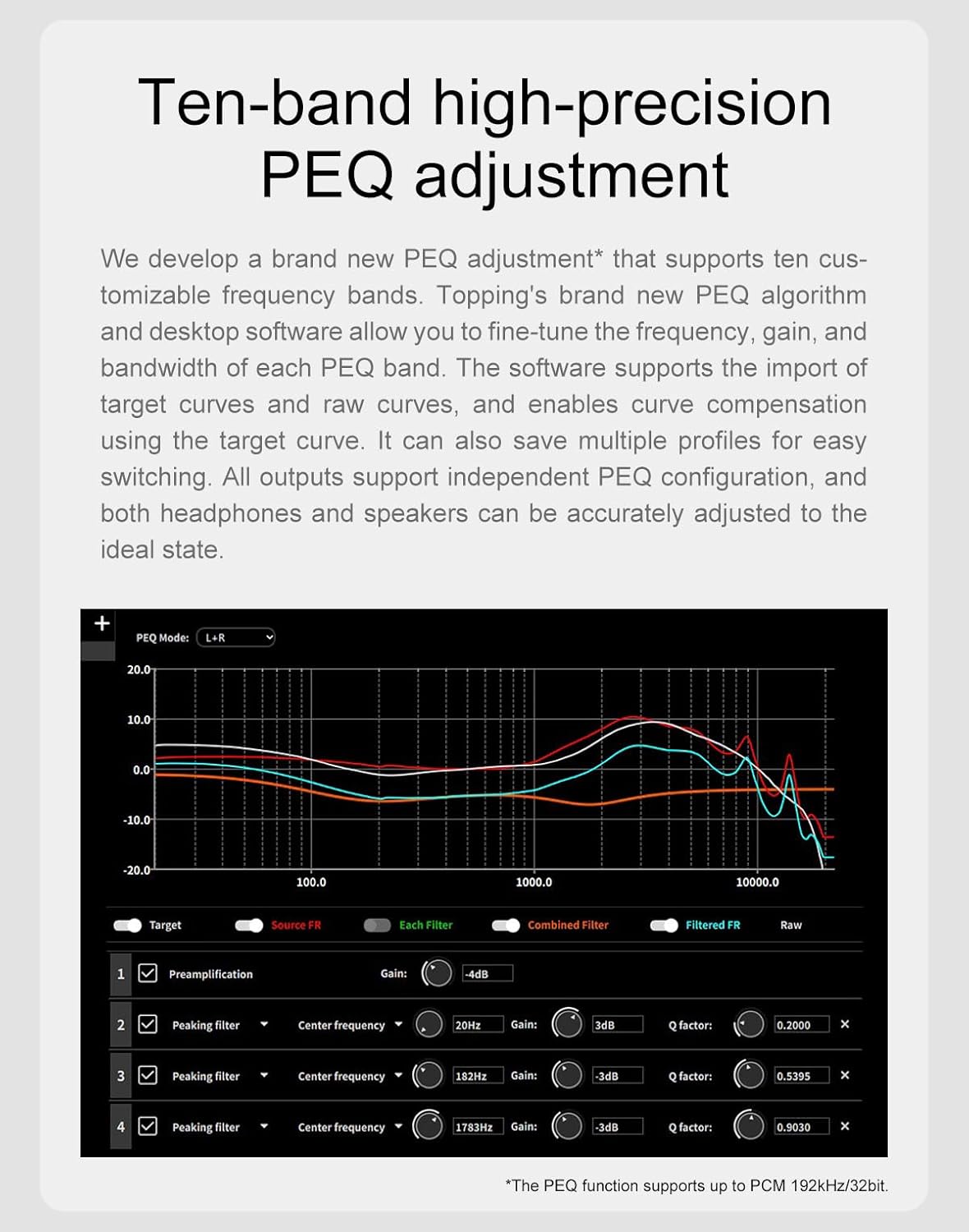
- Hochpräziser 10-Band-PEQ: Desktop software allows tweaking 10 independent frequency bands (frequency, gain, Q-factor adjustment). Multiple profiles can be saved, and EQ can be applied independently to speakers and headphones.
- LDAC-Funkverbindung: Equipped with QCC5125 chip, supporting Bluetooth 5.1 and up to 96kHz/24bit. Fully supports LDAC, aptX-Adaptive, aptX HD, AAC, and SBC audio encodings for high-quality wireless audio.



Offizielles Produktvideo: Überview
3. Anschlüsse und Einrichtung
Proper connection of your DX5II is crucial for optimal performance. Follow these steps to set up your device.
Frontplatte überview
- 4-pin XLR Headphone Output Jack: Für symmetrische Kopfhöreranschlüsse.
- 6.35-mm-Kopfhörerausgangsbuchse: Für unsymmetrische Kopfhöreranschlüsse.
- 4.4mm Balanced Headphone Output Jack: Für symmetrische Kopfhöreranschlüsse.
- Bildschirm: Displays current status, settings, and UI.
- Fernbedienungsempfänger: For infrared remote commands.
- Menü-Schaltfläche: Öffnet das Einstellungsmenü.
- Eingabetaste: Switches input channels.
- Home "Button: Switches home page display modes.
- Volume Knob & User-defined Button: Rotates to adjust volume; press for user-defined functions.
Rückseite überview
- Symmetrischer XLR-Ausgang: For balanced line output to ampVerstärker oder Aktivlautsprecher.
- Single-ended RCA Output: For single-ended line output to ampVerstärker oder Aktivlautsprecher.
- USB Eingang: Verbindet sich mit einem Computer oder einer anderen USB-Audioquelle.
- Optischer SPDIF-Eingang: Connects to optical audio sources.
- Koaxialer SPDIF-Eingang: Connects to coaxial audio sources.
- Bluetooth-Eingang: Für drahtloses Audio-Streaming.
- 12V Trigger IN/OUT (3.5mm jack): For synchronized power control with other devices.
- Power Input (AC 100-277V 50/60Hz): Wird an die Wechselstromversorgung angeschlossen.
- Stromschalter: Schaltet das Gerät ein/aus.

Connecting to Input Sources
The DX5II supports USB, Coaxial, Optical, and Bluetooth inputs. Connect your audio source to the corresponding input port on the rear panel.
Kopfhörer anschließen
Three types of headphone jacks are available on the front panel: 6.35mm single-ended, 4.4mm balanced, and 4-pin XLR balanced. Connect your headphones to the appropriate jack.
Verbindung zu AmpVerstärker oder Aktivlautsprecher
Use XLR or RCA cables to connect the DX5II to your amplifiers or active speakers. Ensure to turn off all devices before making connections to avoid damage.
12-V-Triggeranschluss
The 12V Trigger IN/OUT allows the DX5II to be activated by other devices or to activate other devices via a 3.5mm AUX cable. This enables synchronized power on/off with compatible equipment.
Official Product Video: User Manual Walkthrough
4. Bedienungsanleitung
Familiarize yourself with the operational controls and settings of your DX5II.
Power On & Off / Standby Operation
- Einschalten: Press the power switch on the rear panel.
- Stehen zu: Short press the volume knob on the front panel or use the remote control to enter standby. Press again to exit.
Lautstärkeeinstellung
- Stummschalten/Stummschaltung aufheben: Press the mute button on the remote control.
- Lautstärke anpassen: Drehen Sie den Lautstärkeregler an der Vorderseite oder verwenden Sie die Lautstärketasten auf der Fernbedienung.
Eingabeeinstellungen
The DX5II supports multiple input channels. You can choose between auto-detect or manual selection in the setup menu. Use the Input button on the front panel or remote to switch between active inputs.
Ausgabeeinstellungen
The device allows preselection of commonly used output channels. Options include All (Headphone Outputs), All (Line Outputs), HPA SE (6.35mm), HPA BAL (4.4mm/4-pin XLR), LO SE (RCA), and LO BAL (XLR).
PCM Filter Setting
The DX5II offers various PCM filter options (F-1 to F-8) to fine-tune the sound characteristics.
PEQ Configuration
The 10-band high-precision PEQ can be configured via desktop software. You can save up to 5 custom configurations and apply them offline.
Aurora UI Display
The 2.0-inch full-color screen offers various display modes (Normal, VU, FFT) and customizable background colors. The pressable knob supports customizable functions.
5. Fehlerbehebung
If you encounter any issues with your DX5II, refer to the following common problems and solutions:
- Kein Ton: Check power supply, input selection, cable connections, and upstream devices.
- H/M/L blinks, others are off (Firmware exception): Unplug and re-plug the power cable, then flash the firmware again.
- HML and H/L blinks alternately (Input voltage is high/low): Verwenden Sie das mitgelieferte Netzteil.
- HML and M blinks alternately (Positive and negative voltage anomalies): Check power supply, disconnect other devices, and reboot.
- Blinks only the current gain LED (Headphone amplifier circuit outputs abnormal DC voltage): Change the song or turn down the volume.
Für weitere Unterstützung wenden Sie sich bitte an den Kundendienst.
Official Product Video: Troubleshooting Guide
6. Spezifikationen
Allgemeine Attribute
| Attribut | Wert |
|---|---|
| Gemessene Abmessungen | 19.0cm x 15.5cm x 4.4cm (including protruding parts) |
| Gewicht | 945g |
| Leistungsaufnahme | 100-277 VAC 50 Hz / 60 Hz |
| Signaleingang | USB/BT/OPT/KOAX |
| Line-Out-Ausgang | XLR/Cinch |
| Kopfhörerausgangsbuchse | 6.35mm headphone output jack, 4.4mm headphone output jack, 4-PIN-XLR headphone output jack |
| Andere Anschlüsse | 12V Trigger In (3.5mm jack), 12V Trigger Out (3.5mm jack) |
| Bluetooth-Reichweite | >10 Mio. |
| Anzeige | 2inch LCD |
| Kontrolle | 3 buttons + multifunction knob + Remote control |
| Standby-Stromverbrauch | <1.3 W |
| Energieaufnahme | <6 W |
DX5 II DAC Parameters (LineOut/USB In@96kHz)
| Parameter | Cinch | XLR |
|---|---|---|
| THD+N @1kHz (A-wt) | <0.00008 % | <0.00006 % |
| Klirrfaktor @20-20kHz 90kBw | <0.0005 % | <0.00015 % |
| SNR @1kHz (A-wt) | 128 dB | 132 dB |
| Dynamikbereich bei 1 kHz (A-wt) | 128 dB | 132 dB |
| Frequenzgang | 20Hz-20kHz (±0.3dB), 20Hz-40kHz (±1.0dB) | 20Hz-20kHz (±0.3dB), 20Hz-40kHz (±1.0dB) |
| Ausgangspegel | 2.5 Vrms bei 0 dBFS | 5.0 Vrms bei 0 dBFS |
| Rauschen @A-wt | <1.1 µV effektiv | <1.3 µV effektiv |
| Kanalübersprechen | -135dB bei 1kHz | -147dB bei 1kHz |
| Kanalbalance | 0.3 dB | 0.3 dB |
| Ausgangsimpedanz | 50 Ω | 100 Ω |
Hinweis: Die obigen Daten sind das Ergebnis des Tests im TOPPING-Labor unter AC220V 50Hz-Bedingungen.
DX5 II Kopfhörer Amplifier Specifications (USB In@96kHz)
| Parameter | 6.35-mm-Kopfhöreranschluss | 4.4mm/4-pin XLR headphone jack |
|---|---|---|
| THD+N @1kHz (A-wt) | <0.00008% @Output=20mW (32Ω), <0.00007% @Output=22mW (300Ω) | <0.00007% @Output=85mW (32Ω), <0.00007% @Output=85mW (300Ω) |
| THD @20-20kHz (90kBw) | <0.0005% @Output=20mW (32Ω), <0.0005% @Output=22mW (300Ω) | <0.0005% @Output=85mW (32Ω), <0.0005% @Output=90mW (300Ω) |
| SNR @MAX OUT 1kHz (A-wt) | 131 dB | 133 dB |
| Dynamikbereich bei 1 kHz (A-wt) | 131 dB | 133 dB |
| Frequenzgang | 20Hz-20kHz (±0.3dB), 20Hz-40kHz (±1.0dB) | 20Hz-20kHz (±0.3dB), 20Hz-40kHz (±1.0dB) |
| Ausgangspegel | 7.2Vpp @G=L, 24.2Vpp @G=H | 15.0Vpp @G=L, 48.6Vpp @G=H |
| Rauschen (A-wt) | <2.5uVrms @G=H, <1.1uVrms @G=L | <4.3uVrms @G=H, <1.8uVrms @G=L |
| Kanalübersprechen | -127dB bei 1kHz | -143dB bei 1kHz |
| Gewinnen | G=L 8.6dB (Vrms/FS), G=H 18.7dB (Vrms/FS) | G=L 14.6dB (Vrms/FS), G=H 24.7dB (Vrms/FS) |
| Kanalbalance | 0.3 dB | 0.3 dB |
| Ausgangsimpedanz | <0.1Ω | <0.1Ω |
| Ausgangsleistung | 3300mW x 2 @16Ω THD+N<1%, 2200mW x 2 @32Ω THD+N<1%, 1160mW x 2 @64Ω THD+N<1%, 250mW x 2 @300Ω THD+N<1%, 120mW x 2 @600Ω THD+N<1% | 7600mW x 2 @16Ω THD+N<1%, 6400mW x 2 @32Ω THD+N<1%, 4300mW x 2 @64Ω THD+N<1%, 990mW x 2 @300Ω THD+N<1%, 490mW x 2 @600Ω THD+N<1% |
| Lastimpedanz | > 8 Ω | > 8 Ω |
Hinweis: Die obigen Daten sind das Ergebnis des Tests im TOPPING-Labor unter AC220V 50Hz-Bedingungen.
7. Sicherheitsvorkehrungen
- Bewahren Sie das Gerät nicht in einer heißen, feuchten Umgebung auf und schlagen Sie es nicht stark an.
- Beim Öffnen des Gehäuses erlischt sofort die Garantie!
- Nur zur Verwendung im Innenbereich.
- Topping übernimmt keine Haftung für Verluste oder Schäden, die direkt oder indirekt aus dem Ausfall von DX5 II entstehen.
- Aus Verbesserungsgründen können die Spezifikationen ohne vorherige Ankündigung geändert werden.
8. Garantie und Support
Hificollege aims for 100% customer satisfaction. We offer authoritative certification, ensuring 100% authenticity of all products sold. Our support team is ready to answer any questions 24/7. We provide more than 1 year of quality restoration, covering repair and shipping costs. We also offer a lowest price match within 30 days.
